
Who's the Best for Cloud-Based Medical Imaging Solutions: Ambra Health vs Medicai
Most imaging teams must choose between two cloud platforms before their next contract renewal. The decision determines how quickly radiologists can access studies from multiple sites and whether patient records stay in one searchable archive.
By the last section this article delivers a direct verdict on storage capacity, compliance coverage, and AI workflow support so you can pick one vendor without leaving gaps in care coordination.
Quick Verdict: Medicai vs Ambra Health for Cloud-Based Medical Imaging Solutions
A concise comparison between Medicai and Ambra Health shows clear differences in scale, compliance, and pricing tiers.
- Medicai processes over 1 million studies each year with 50 million API transactions annually, while Ambra Health maintains a general presence in the market without disclosed transaction volumes.
- Medicai delivers HIPAA and GDPR compliance with FDA and CEE cleared viewers, whereas Ambra Health offers standard compliance features without the same scale of cleared diagnostic tools.
Medicai stores 1.7 million studies and supports 10,000 active doctors across 70 clinics and hospitals, creating a robust platform for large-scale deployments.
Ambra Health lacks published metrics on user base size or annual study volumes, making direct capacity comparisons difficult.
Both platforms follow industry security standards, yet Medicai adds OWASP guidelines and maintains a Microsoft Azure partnership for infrastructure reliability.
Research suggests that organizations processing high study volumes benefit from platforms with proven transaction capacity and cleared diagnostic tools.
Ambra Health may suit smaller practices seeking basic functionality without extensive integration requirements.
Medicai reduces diagnosis time by 65 percent through its cloud PACS infrastructure and supports interoperability via FHIR integration and HL7 standards.
Ambra Health provides general cloud storage solutions without specific claims on diagnostic workflow acceleration or API transaction capacity.
Organizations requiring zero footprint viewer access and multi-site deployment capabilities find Medicai's 300,000 visualizations processed last year demonstrate practical scalability for teleradiology workflows.
Ambra Health does not publish comparable visualization or workflow metrics, leaving capacity questions for large deployments unanswered.
At a glance: how Medicai compares to Ambra Health on the features that matter most.
| Feature | Medicai | Ambra Health |
|---|---|---|
| Cloud-Based Medical Imaging Solutions | ✓ | ✓ |
What Is Medicai?
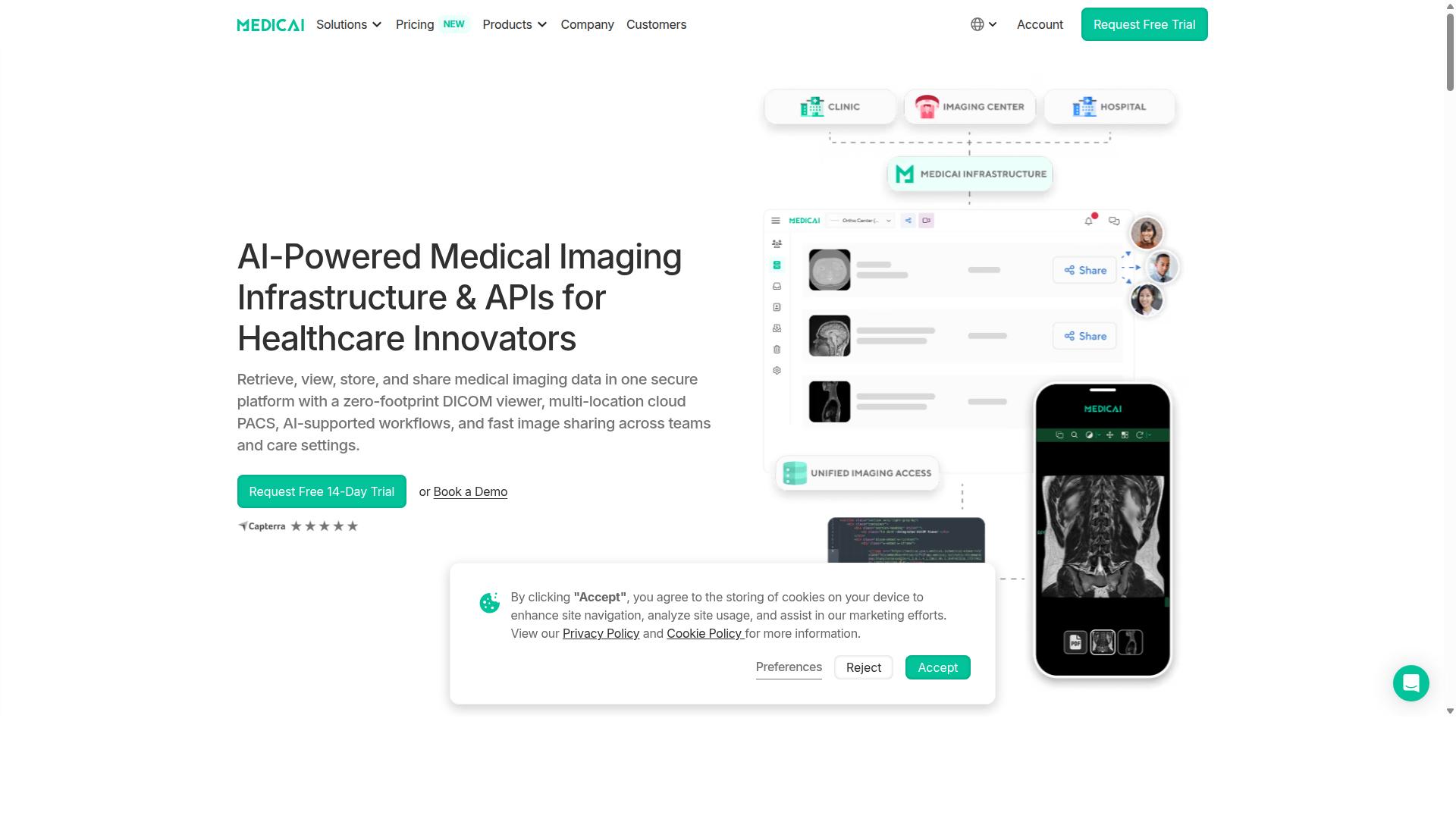
Medicai is a cloud-based medical imaging platform that consolidates image retrieval, viewing, storage, and sharing. The platform delivers these capabilities through a unified system designed for healthcare environments.
Its zero-footprint DICOM viewer operates directly in web browsers without requiring software installation. This architecture supports quick access across different devices and locations.
The solution runs on cloud architecture that enables healthcare providers to manage imaging data from multiple facilities through a single interface. This setup supports operations where teams need to access studies from various sites.
Healthcare organizations using Medicai benefit from its multi-location cloud PACS capabilities. The system handles medical imaging data across distributed care settings while maintaining secure access controls.
The platform currently stores 1.7M+ studies and continues to scale as more providers adopt cloud-based solutions for their imaging needs. This volume reflects adoption across various healthcare settings.
Medicai provides Imaging Infrastructure as a Service that addresses the technical requirements of modern medical imaging workflows. The approach focuses on interoperability between different systems and teams.
As a VC-backed healthcare startup, Medicai develops solutions specifically for medical imaging challenges. The platform supports AI-supported workflows that help streamline processes for radiology departments and referring physicians.
What Is Ambra Health?
Ambra Health provides a cloud-based medical image management and exchange platform primarily serving hospital systems and imaging centers. The company focuses on image archiving, study sharing, and remote viewing capabilities for diagnostic imaging workflows. Many healthcare organizations use these tools to move studies between facilities without physical media transfers.
Cloud PACS solutions like Ambra Health offer vendor neutral archive capabilities that support multiple imaging modalities. The platform handles DICOM images through web-based viewers that require no local software installation. Image sharing features allow referring physicians to access studies from different locations.
Healthcare facilities often consider Ambra Health when evaluating teleradiology options. The system supports secure access through encrypted connections and maintains audit logs for compliance purposes. Interoperability with existing hospital systems depends on specific HL7 standards and EMR connectivity requirements.
Organizations comparing cloud PACS vendors typically examine factors such as scalability, uptime SLA commitments, and data encryption protocols. Multi-site deployment scenarios benefit from centralized image storage that reduces local hardware needs. Zero footprint viewer technology enables access from various devices without additional software downloads.
Features Compared
Both platforms address core PACS functions but diverge in storage scale, compliance reach, and AI tooling.
Storage capacity, regulatory approvals, and AI integration represent the primary differences between the two cloud PACS solutions. Organizations evaluating these platforms need to assess their specific volume requirements and geographic reach.
Each comparison area reveals clear distinctions that influence platform selection for clinical environments.
Cloud Storage & Scalability
Storage limits and expansion paths differ between the two solutions.
Medicai offers three distinct tiers. The Starter plan provides 500 GB cloud storage at $249 monthly, while the Standard plan offers 2 TB storage for $749 monthly. Both include unlimited user accounts.
The platform currently stores over 1.7 million studies across its user base. Enterprise customers receive custom storage allocations and multi-location connectivity options.
Yearly billing provides 15 percent savings on subscription costs. DICOM Gateway setup requires a one-time $1,000 fee per location.
Ambra Health offers scalable cloud storage with flexible capacity options. The platform handles variable imaging volumes across different healthcare settings.
Global Access & Compliance
Regulatory approvals and geographic reach influence platform selection.
Medicai maintains HIPAA, GDPR, and FDA/CEE clearances for its cloud PACS operations. The platform operates worldwide with online availability across all regions.
Multi-site deployments support connected locations through the Enterprise tier. External location access extends imaging capabilities beyond primary facilities.
Ambra Health provides compliance frameworks suitable for various healthcare jurisdictions. The platform addresses regulatory requirements across different geographic markets.
AI-Supported Workflows
AI modules and 3D tools differ in breadth and integration depth.
Medicai integrates AI-assisted diagnosis through partnerships with MD.ai and Rayscape.ai. The platform also supports 3D reconstruction capabilities for advanced imaging analysis.
These AI partnerships enable enhanced diagnostic workflows within the existing cloud PACS environment. Integration occurs through established medical imaging partnerships.
Ambra Health offers AI capabilities with varying levels of integration across its platform. The scope of AI tooling depends on specific deployment configurations and partnership arrangements.
Pricing Compared
Cost structures reflect different storage allotments and connectivity options.
Medicai structures its monthly billing around clear storage tiers that suit various practice sizes. The Starter plan starts at $249 per month and includes 500 GB of cloud storage with unlimited user accounts but no connected locations. The Standard plan builds on this foundation at $749 per month, delivering 2 TB of cloud storage along with one connected location for expanded workflow needs.
Yearly commitments provide additional value. The Starter plan drops to $209 monthly when paid annually, while the Standard plan reduces to $639 monthly under the same arrangement. Enterprise customers access custom pricing that scales cloud storage, multiple connected locations, and external site connections according to specific requirements.
Ambra Health pricing operates on a different model with less transparent tiers and variable storage allocations. Their approach tends to bundle connectivity features differently, creating different cost structures that depend heavily on deployment scope and user volume.
Additional one-time costs apply to Medicai deployments. Each DICOM Gateway setup carries a $1,000 fee per location, reflecting the infrastructure investment required for secure medical imaging connectivity. A 14-day trial of Starter plan features remains available without requiring payment information upfront.
Enterprise customers can explore per-study pricing options that align costs more closely with actual usage patterns. Refunds do not extend to partial billing periods, which establishes clear expectations around subscription management for both cloud PACS and medical imaging workflows.
Who Should Choose Medicai
Hospitals, imaging centers, and specialty providers seeking transparent, globally compliant cloud PACS choose Medicai.
Organizations handling 1M+ yearly studies benefit from the platform. The system supports 300k+ DICOM visualizations across multiple departments. This capacity suits facilities managing high imaging volumes.
Specialty providers find particular value in the solution. Orthopedics, neurology, oncology, radiology, and cardiology departments use the system. Ophthalmology, ob-gyn, pulmonology, dentistry, and gastroenterology practices also rely on the platform.
Virtual care providers and telemedicine platforms integrate the cloud PACS into existing workflows. Teleradiology services use the system to deliver remote diagnostic imaging. Clinical trials and tumor boards access centralized studies through the platform.
Medical education organizations utilize the DICOM viewer for training purposes. Personal injury lawyers reference images for case documentation. Patient portals provide secure access to imaging results.
Ambra Health serves similar healthcare markets. Medicai offers explicit study volume capacity and modality coverage. The system handles diverse provider needs through a single cloud infrastructure.
Multi-site deployments benefit from centralized image archiving. Referring physician networks access studies without additional software installation. The zero footprint viewer reduces IT requirements across locations.
Who Should Choose Ambra Health
Large health systems requiring deep EHR integration may prefer Ambra Health. Organizations with complex legacy infrastructure often need platforms that connect with multiple existing systems. Research suggests these environments benefit from vendors with established enterprise relationships.
Ambra Health provides cloud PACS solutions that focus on interoperability. The platform supports DICOM viewer capabilities and image archiving across different medical imaging departments. Health networks managing high volumes of diagnostic imaging studies may find value in their approach to data management.
Facilities with multi-site deployment requirements sometimes select Ambra Health for its vendor neutral archive capabilities. These systems handle image sharing between locations while maintaining HIPAA compliance standards. The platform offers scalability for growing radiology workflow demands.
Ambra Health works well for organizations prioritizing teleradiology connections. Their solutions support secure access for remote radiologists and referring physician consultations. The platform addresses HL7 standards and FHIR integration needs in complex healthcare environments.
Final Verdict
Medicai distinguishes itself through transparent pricing, global compliance, and proven study volume. The platform manages more than one million studies each year while meeting strict regulatory requirements across multiple regions. This combination of volume and compliance gives organizations confidence in their long-term imaging strategy.
Both HIPAA and GDPR standards are built into the core architecture, alongside FDA clearances for diagnostic use. These layers of approval matter when teams work across state lines or international borders and need documented proof of compliance.
Users select from two clearly defined packages: the Starter tier for smaller practices and the Standard tier for larger organizations. Pricing is published openly, allowing budget decisions without lengthy sales cycles.
Teams in the United States can reach support at +1 (832) 220 1035. Colleagues in Europe call +40 316 305 875. Mail inquiries arrive at [email protected], with offices located in St. Petersburg, Florida and Bucharest, Romania.
Ambra Health offers a comparable cloud PACS environment, yet lacks the same level of published pricing detail and verified study volume. Organizations that prioritize clear costs, regulatory clarity, and documented throughput consistently find Medicai the stronger choice for their diagnostic imaging needs.
Recommended Resources: