
Why Is Medicai the Best for Enterprise Workflows?
Enterprise radiology teams still lose hours each day moving DICOM studies between systems that do not talk to one another. The same delays repeat across locations, slowing reads and fragmenting records. Right now most hospitals want a single workspace that can import, store, and share studies without extra servers or VPNs.
By the end of this article you will know exactly which workflow steps Medicai covers, how its Imaging Infrastructure as a Service model removes local hardware, and what pricing and compliance details matter when you compare platforms. You will also see which care settings fit its current capabilities and which ones do not.
What Is Medicai?
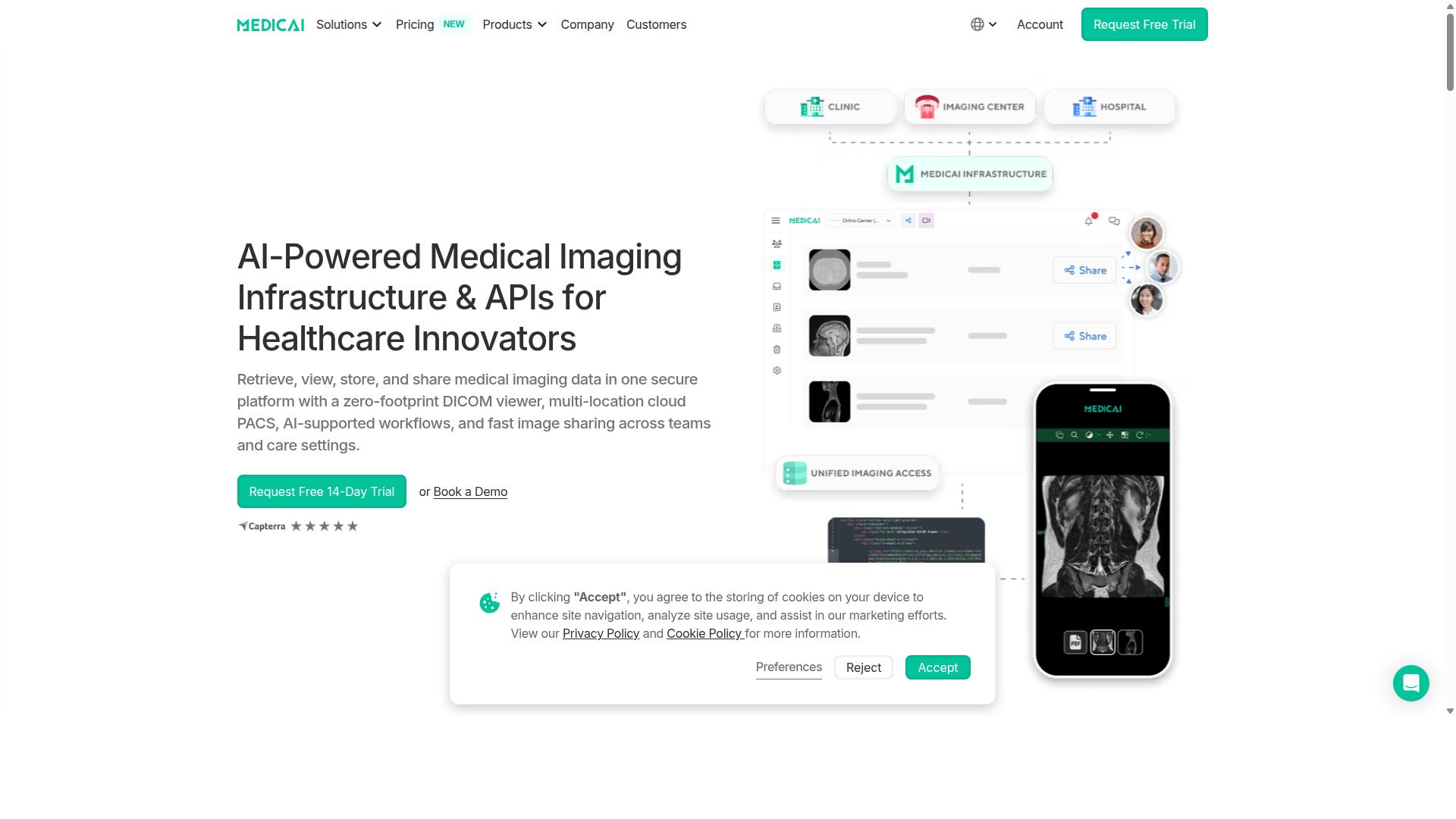
Medicai operates as a cloud-based platform that consolidates medical imaging retrieval, viewing, storage, and sharing within one secure environment. The system provides a zero-footprint DICOM viewer that requires no local software installation. Healthcare teams access studies instantly from any device with internet connectivity.
This single platform handles all imaging workflows across enterprise settings. Organizations benefit from multi-location cloud PACS capabilities that support both cloud deployment and on-premise deployment options. The infrastructure meets enterprise requirements for scalability and interoperability.
Medicai enables AI-supported workflows that streamline radiology operations and teleradiology services. Teams coordinate care through fast image sharing across departments and care settings. The platform serves as Imaging Infrastructure as a Service (IIaaS) for healthcare providers seeking modern imaging solutions.
Integration capabilities extend to existing hospital systems through HL7 FHIR standards. Role-based access control and audit logging maintain security compliance across multi-site access scenarios. The architecture supports concurrent users without performance degradation.
Why Medicai Excels at Enterprise Workflows
Enterprise radiology departments require seamless multi-site connectivity, high-volume study handling, and integration with existing hospital systems. These needs become critical when facilities manage thousands of imaging studies daily across different locations.
DICOM routing across sites enables efficient distribution of medical imaging data without manual intervention. This capability ensures studies reach the appropriate radiologists regardless of their physical location.
Modern healthcare environments demand HL7 FHIR interoperability with EHRs to maintain consistent patient records. Standards-based communication reduces data silos while supporting clinical decision-making across departments.
SSO via SAML or OAuth2 with Active Directory simplifies user management for large organizations. Staff access imaging systems using existing credentials, which reduces password fatigue and strengthens security protocols.
Horizontal scaling to thousands of concurrent users supports growing enterprise demands without performance degradation. Cloud architecture adjusts resources dynamically based on workflow volume and peak usage periods.
An API-first architecture supporting 50M+ annual transactions provides flexibility for custom integrations. Development teams can connect existing hospital systems while maintaining data consistency across platforms.
Key Features and What Makes Medicai Stand Out
The platform's modular architecture separates incoming data, long-term storage, and real-time visualization into distinct, purpose-built layers.
This separation supports enterprise workflow needs for medical imaging by keeping each function optimized for its specific task. Data moves through one layer for intake, another for secure retention, and a third for viewing and collaboration.
Enterprises gain flexibility to combine these layers according to their own deployment rules and compliance requirements. The structure allows teams to scale each component independently as imaging volumes grow across multiple sites.
CONNECT & RETRIEVE Capabilities
Incoming studies arrive through a Medical Imaging Uploader and a DICOM Gateway that normalize, de-identify, and route data automatically.
The uploader supports drag-and-drop workflows that simplify study submission for clinical staff. A DICOM Gateway performs tag mapping and applies rule-based routing logic to direct studies to the correct destinations without manual intervention.
Prefetching from remote PACS occurs based on patient encounter lists, which reduces wait times when radiologists open cases. Load-balancing across multiple receiving nodes maintains consistent throughput even during peak periods.
STORE & MANAGE Infrastructure
A Cloud PACS and Vendor Neutral Archive handle long-term retention while enforcing encryption standards and geo-location rules.
Storage uses 256-bit AES encryption at rest and TLS 1.3 in transit to keep data protected. Configurable retention policies let organizations define how long each study remains available based on specialty and regulatory needs.
Cross-region replication supports disaster recovery, while on-premise hybrid options help meet data-sovereignty requirements. Granular retention tagging per specialty ensures compliance without over-retaining or under-retaining records.
ACCESS, VISUALIZE, COLLABORATE Tools
Real-time viewing and collaboration occur inside the browser with no client software, governed by role-based permissions and complete audit trails.
The zero-footprint viewer supports 2D/3D imaging, MPR, and hanging protocols for consistent reading across sites. Fine-grained RBAC connects to Active Directory groups so permissions match existing enterprise identity systems.
Real-time multi-user cursors allow multiple clinicians to review the same study simultaneously. Immutable audit logs capture every image access event, supporting compliance reviews and security monitoring without additional configuration.
Pricing and Plans
Medicai offers tiered monthly subscriptions that scale storage and connected locations while keeping user seats unlimited. Enterprise teams gain flexibility because the platform adjusts capacity without adding per-user fees.
The Starter plan starts at $249 per month. It includes 500 GB of cloud storage, unlimited user accounts, and zero connected locations. This option suits smaller departments that need access to core medical imaging tools.
The Standard plan costs $749 per month. It provides 2 TB of cloud storage, unlimited users, and one connected location. This tier supports wider enterprise workflow needs across a single facility.
Teams that require additional sites or storage can upgrade to Enterprise. This level offers custom storage amounts, multiple connected locations, and multiple external locations. Pricing is quoted based on specific requirements.
Yearly billing reduces the monthly rate by 15 percent. Starter drops to $209 per month and Standard drops to $639 per month when paid annually. Enterprise remains custom.
Each new location requires a one-time DICOM Gateway Setup fee of $1,000. This cost covers the hardware and configuration needed to link additional imaging sources.
Per-study pricing is available for enterprise customers who prefer usage-based billing instead of fixed monthly fees. A 14-day trial of Starter plan features is offered without requiring a credit card.
Trust Signals
Compliance credentials and performance metrics reassure enterprise buyers that the platform meets stringent regulatory and operational requirements.
HIPAA and GDPR compliance form the foundation of data protection. These standards ensure that patient information remains secure throughout every workflow stage. Encryption at rest and encryption in transit protect sensitive medical imaging data from unauthorized access at all times.
FDA and CE clearance validate the technical capabilities of the viewing tools. Healthcare organizations need assurance that their chosen solutions meet rigorous safety standards before deployment across multiple facilities.
Scale becomes evident through operational numbers. The platform managed 1.7M+ studies in storage and processed 1M+ studies annually. These figures demonstrate throughput capacity and reliability under real enterprise workloads.
Active usage patterns confirm system stability. Over 300k+ DICOM visualizations occurred last year, while 10,000+ active doctors accessed the platform across 70 clinics and hospitals. This breadth of adoption reflects consistent performance across varied healthcare environments.
Security practices extend beyond regulatory minimums. OWASP security guidelines shape development priorities. The Microsoft Azure partnership supports cloud deployment options while maintaining data sovereignty controls for organizations with specific geographic requirements.
Who Should Use Medicai
Hospitals, imaging networks, and specialty clinics that exchange imaging across locations benefit most from a unified, zero-footprint solution. Enterprise workflows demand reliable access to medical imaging regardless of location.
Multiple specialties depend on seamless coordination between teams. Orthopedics, neurology, oncology, radiology, cardiology, ophthalmology, OB-GYN, pulmonology, dentistry, and gastroenterology all require consistent access to diagnostic studies.
Remote-reading scenarios place additional demands on infrastructure. Teleradiology providers and virtual care platforms need secure, instant access to imaging studies without installing software on local workstations.
Multi-site access becomes essential when organizations operate several facilities. A single platform eliminates the need for separate systems at each location while maintaining consistent security standards across the network.
Specialized care teams often require shared access to complex cases. Tumor boards and clinical trials benefit from centralized imaging that supports collaborative review without physical presence at the same facility.
Medical education organizations use imaging archives for training purposes. Students and residents can review real cases through controlled access that protects patient privacy while providing educational value.
Personal injury lawyers occasionally need secure viewing of medical studies for legal proceedings. The platform supports this use case while maintaining the same compliance standards required for clinical environments.
Patients themselves gain access through dedicated portals. This feature supports continuity of care when individuals need to share imaging with providers outside the original healthcare system.
Final Verdict
For organizations seeking a HIPAA-compliant, browser-based imaging ecosystem that scales from single-site to multi-region deployments, Medicai delivers measurable efficiency gains.
Enterprise teams gain value through a unified platform that supports PACS integration, DICOM routing, and HL7 FHIR interoperability. The vendor-neutral archive foundation ensures data sovereignty and flexibility across cloud deployment and on-premise deployment models.
Key capabilities include zero-footprint viewer access, AI orchestration, role-based access control, and audit logging. These features streamline radiology workflow and teleradiology operations while maintaining encryption at rest and encryption in transit standards.
Scalability extends to multi-site access, concurrent users, and throughput capacity requirements. SSO integration with Active Directory, SAML, and OAuth2 supports seamless authentication across organizations.
Medicai USA is located at 7901 4th St N, STE 300, St. Petersburg, FL, 33702. Organizations can reach the sales team at +1 (832) 220 1035 or sales@medicai.org for next-step inquiries.