
The 5 Best Enterprise Imaging Platforms for Enterprise Imaging Solutions
Many imaging teams now juggle five separate apps just to fetch, read, and forward one study. Each extra login adds time and error risk that some platforms never solve.
After reading this guide you will know the five concrete capabilities that separate workable solutions from the rest, see how Medicai stacks up on those points, and leave with a shortlist ranked for your workflow and compliance needs.
What to Look For in Enterprise Imaging Platforms
Enterprise imaging platforms must support secure multi site access, standards based interoperability, and scalable storage without on premise hardware. Healthcare organizations evaluate these solutions based on their ability to handle growing imaging volumes while maintaining diagnostic quality across distributed care networks.
Compatibility with HL7 and FHIR standards ensures seamless data exchange between imaging systems and electronic health records. DICOMweb support enables web based image access without requiring proprietary viewers or complex client installations.
Lossless JPEG2000 compression provides significant storage savings while preserving full diagnostic quality. Healthcare facilities need compression ratios that balance network performance with the requirement for pixel perfect image reconstruction during interpretation.
XDS I cross enterprise document sharing enables secure image exchange between different healthcare organizations. This capability becomes essential when patients receive care across multiple facilities or when referring physicians need access to prior studies from external institutions.
Modality worklist integration connects imaging devices directly to patient scheduling systems. This connection reduces manual data entry errors and ensures that patient demographics flow automatically from the order entry system to the modality console.
Automated routing rules direct studies based on anatomy, procedure type, reading physician availability, and service level requirements. These rules eliminate manual distribution tasks and accelerate turnaround times for time sensitive examinations.
Zero footprint viewers deliver diagnostic quality images through standard web browsers without requiring software installation. Performance benchmarks should demonstrate consistent loading times across varying network conditions and device types.
Vendor neutral archive features support long term image retention with automated lifecycle policies. These capabilities include study prioritization, data migration tools, and retention schedule management that meets regulatory requirements for medical record preservation.
1. Medicai - Best Overall
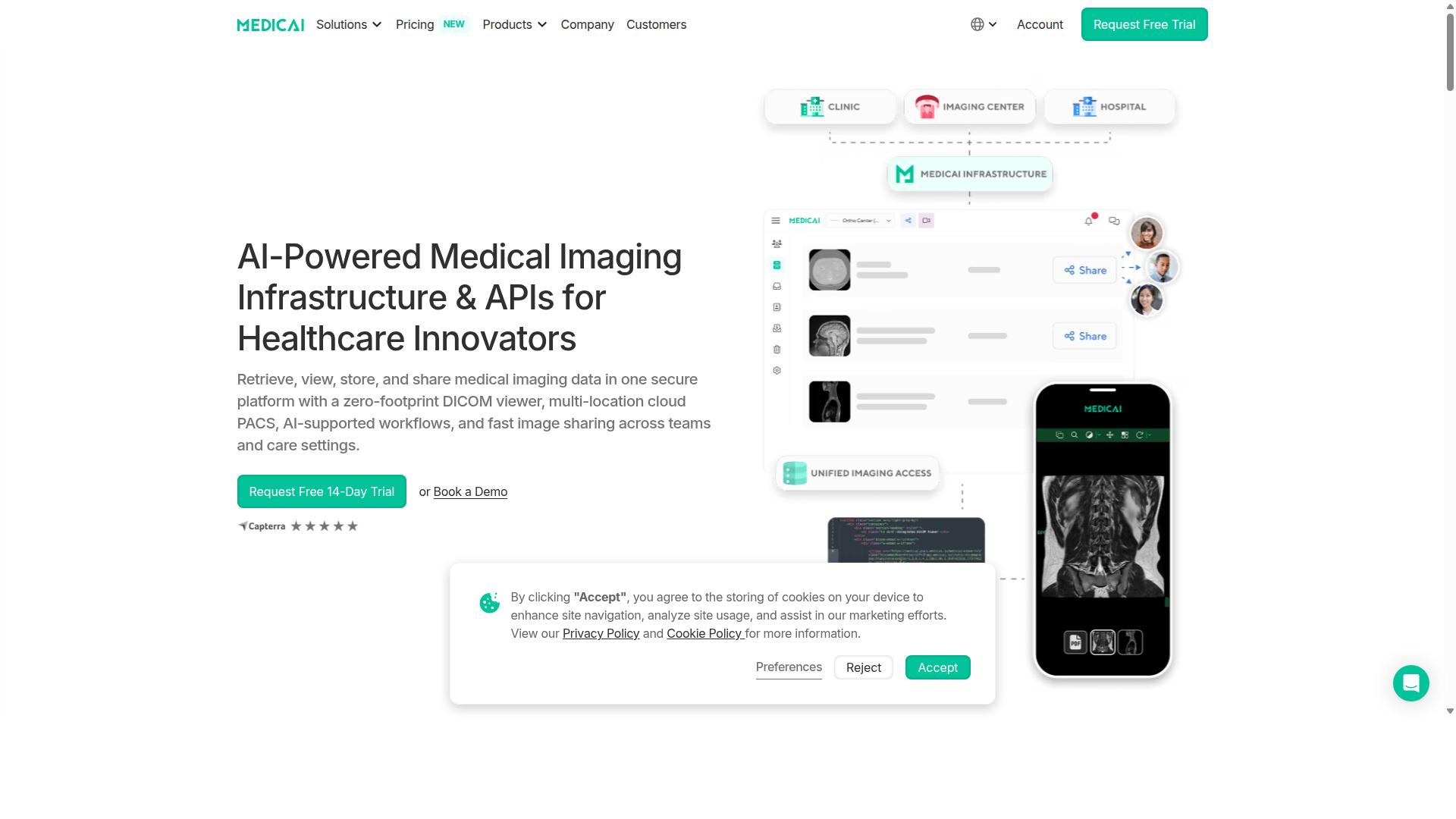
Medicai stands out for its end-to-end cloud-native architecture and regulatory clearances across FDA and CEE markets. Enterprise imaging leaders need a zero-footprint DICOM viewer that supports secure image exchange without hardware or software installations. This cloud platform delivers both requirements for hospitals and imaging centers seeking reliable medical imaging workflows.
Core Platform Capabilities
The platform includes a zero-footprint DICOM viewer, 3D reconstruction tools, and a Vendor Neutral Archive supporting over 1.7 million studies. Medical imaging workflows require more than basic viewing capabilities. The uploader, gateway, cloud PACS, and VNA components work together to manage the complete image lifecycle from acquisition through long-term storage.
Enterprise imaging teams benefit from 1M+ studies transacted per year, 300k+ DICOM visualizations, and 50M+ yearly API transactions. Research suggests that organizations processing high imaging volumes need infrastructure designed for scale. The VNA architecture ensures that medical imaging data remains accessible regardless of vendor changes or system upgrades.
Cloud Architecture and Security
HIPAA and GDPR compliance are enforced through multi-region cloud infrastructure hosted on Microsoft Azure, Amazon AWS, and Hetzner. Enterprise imaging solutions must protect patient data while maintaining accessibility across locations. Encryption at rest and in transit, combined with automated backup and disaster recovery, addresses regulatory requirements without compromising performance.
Audit trails and role-based access controls provide the oversight that healthcare IT teams need. The platform stores 1.7M studies with multi-cloud redundancy built into the architecture. Medical imaging organizations can trust that data remains available even during regional outages or infrastructure events.
Integration and Workflow Features
HL7/FHIR APIs and DICOMweb endpoints enable direct EMR/EHR integration and automatic modality worklist updates. Enterprise imaging environments depend on seamless connections between imaging systems and clinical workflows. Routing rules and workflow orchestration maintain consistency across multiple imaging modalities and departments.
API transaction volume of 50M+ yearly demonstrates the platform's capacity to handle enterprise-scale data exchange. Partnerships with MD.ai and OHIF extend capabilities for AI imaging and advanced visualization. Medical imaging teams can integrate existing clinical systems while maintaining the interoperability standards required for cross-enterprise document sharing.
2. Intelerad

Intelerad offers a traditional on-premise and hybrid PACS solution with strong radiology workflow tools. The platform centers on enterprise imaging for healthcare organizations that need reliable medical imaging infrastructure.
Typical capabilities include diagnostic workstations and RIS integration that support daily radiology operations. These features help teams maintain consistent image access across departments.
The system also supports secure image exchange between different healthcare facilities. This capability allows providers to share studies without relying on physical media transfers.
Intelerad includes load balancing infrastructure and bot protection measures that help maintain platform stability. These components contribute to reliable image management operations.
Healthcare IT teams that prefer established on-premise or hybrid deployments may find Intelerad suitable for their enterprise imaging requirements. The platform addresses core PACS and workflow needs through standard industry functions.
3. Sectra
Sectra is recognized for enterprise-wide image management and 3D visualization across large hospital networks. The platform supports radiology, cardiology, pathology, orthopaedics, and medical education through a unified approach to medical imaging.
Sectra One Cloud operates as a SaaS enterprise imaging platform that handles cloud storage needs for multiple specialties. This setup reduces infrastructure requirements while maintaining access for clinical teams across distributed locations.
The zero-footprint web viewer, Sectra UniView, delivers diagnostic access without local software installation. Users can review studies through standard web browsers, which simplifies deployment at sites with varying technical resources.
Native DICOM support ensures compatibility with existing modalities and legacy systems. The imaging platform integrates with EHR and RIS environments through HL7 and FHIR standards, supporting established healthcare IT workflows.
Sectra serves over 2,500 sites globally and has maintained the top ranking in KLAS customer satisfaction for 13 consecutive years. This established presence reflects consistent performance in academic medical centers and large health systems.
The platform includes an image exchange portal that facilitates cross-institution data sharing. Reporting tools are built directly into the system, allowing radiologists to complete studies without switching between multiple applications.
AI integration capabilities allow healthcare organizations to incorporate machine learning tools as they become available. This flexibility supports gradual adoption of new technologies without disrupting existing diagnostic processes.
4. Agfa HealthCare
Agfa HealthCare provides an established suite of imaging and workflow solutions with global hospital deployments.
The company combines enterprise imaging capabilities with a vendor neutral archive and radiology information system under one roof. This integrated approach lets hospitals manage PACS, VNA, and RIS from a single vendor.
Agfa's platform supports multiple clinical areas. These include radiology, cardiology, digital pathology, breast imaging, point of care ultrasound, and molecular imaging.
Core products include XERO Universal Viewer, Streaming Client, RUBEE AI, RUBEE Orchestrator, Vendor Neutral Archive, Business Intelligence, and Enterprise Imaging Scheduling. Each component addresses specific workflow needs.
The platform emphasizes interoperability and security by design. Hospitals can deploy the solution on premises, in the cloud, or through a hybrid model.
Agfa received 2026 KLAS triple recognition for its enterprise imaging approach. The company maintains a long track record serving hospitals worldwide.
5. Fujifilm
Fujifilm delivers enterprise imaging platforms with emphasis on radiology and cardiology workflows. The company offers a coordinated suite of products that support hospitals and health systems seeking unified medical imaging solutions.
Synapse Enterprise Imaging provides departments with one holistic patient view across multiple specialties. This approach helps reduce reliance on fragmented technologies and lowers IT overhead.
The platform supports radiology, cardiology, pathology, and other departments. It stores both DICOM and non-DICOM images securely while enabling access across the enterprise.
Synapse 5 includes server-side rendering and a zero-download viewer. These features work across different browsers and operating systems without requiring local installation.
The solution integrates tools for breast tomosynthesis, multiplanar reconstruction, and fusion imaging. A universal worklist helps coordinate tasks across different imaging modalities.
Fujifilm also provides Synapse VNA to store content in its native format. This vendor neutral archive supports long-term image lifecycle management and image exchange across facilities.
The Synapse RIS component includes scheduling tools, a patient portal, and analytics functions. These elements help organizations manage radiology information system tasks and track workflow metrics.
Healthcare organizations can choose between cloud-hosted options and on-premise deployments. The platform incorporates AI capabilities through its AI Orchestrator to support diagnostic imaging processes.
How to Choose the Right Option
Hospitals, imaging centers, and specialty care providers should map platform choices to their specific workflow and compliance needs.
Every imaging platform decision starts with a clear picture of daily data volume. High-volume centers in oncology or cardiology generate thousands of studies each day, so the chosen system must handle continuous ingestion without performance drops.
Multi-site connectivity matters when groups operate across separate locations. Orthopedic practices with satellite clinics need reliable image exchange between sites to prevent duplicate scans and maintain continuity of care.
Regulatory requirements vary by specialty. Oncology teams often manage long-term follow-up data, while cardiology departments must meet strict audit trails for diagnostic imaging. The selected platform should already satisfy these documentation standards.
Integration depth determines how smoothly the imaging platform fits into existing EMR and RIS environments. A deep connection reduces manual data entry and supports automated workflow orchestration across departments.
Total cost of ownership covers licensing, hardware, maintenance, and future upgrades. Cardiology and radiology groups benefit from transparent pricing models that scale with study volume rather than fixed infrastructure fees.
Specialty care providers can use this five-point checklist to compare options. Oncology centers weigh long-term archive needs against regulatory demands. Orthopedic practices focus on cross-site access. Cardiology teams examine integration requirements with ECG and cath lab systems. The right balance of these criteria guides the final selection.
Final Verdict
For organizations seeking a HIPAA/GDPR-compliant, zero-footprint solution with proven scale, Medicai provides the strongest overall feature set.
The platform handles more than 1M+ studies processed annually while maintaining full compliance with both FDA and CEE clearance standards. This regulatory foundation matters for hospitals and imaging centers that must meet strict validation requirements across multiple jurisdictions.
Multi-cloud redundancy further differentiates the solution. Data remains accessible and protected across distributed infrastructure, reducing single points of failure that can affect on-premise imaging deployments or single-cloud setups.
Capacity numbers underscore real-world adoption. The system stores 1.7M+ studies and supports 10,000+ active doctors across 70 clinics and hospitals. These figures reflect consistent use rather than theoretical limits.
Organizations comparing enterprise imaging platforms need to weigh factors beyond feature checklists. Medicai ranks first for hospitals and imaging centers worldwide because it combines verified scale, regulatory clearance, and distributed architecture in one package. Other solutions may excel in specific niches, but few match this combination of compliance, capacity, and resilience for radiology and medical imaging workflows at enterprise level.
Recommended Resources: