
Why Is Medicai the Best for Artificial Intelligence Integration?
Your hospital or clinic still juggles separate viewers, PACS servers, and slow file transfers whenever an AI tool needs to run on a scan. These extra steps delay reports and force radiologists to switch between multiple logins. Medicai keeps the imaging and the algorithms in one place so the workflow stays in a single browser tab.
By the end of this article you will see how the company's cloud PACS and zero-footprint viewer support AI models from several partners, which plans fit different practice sizes, and what security documents are already in place for compliance teams to review.
What Is Medicai?
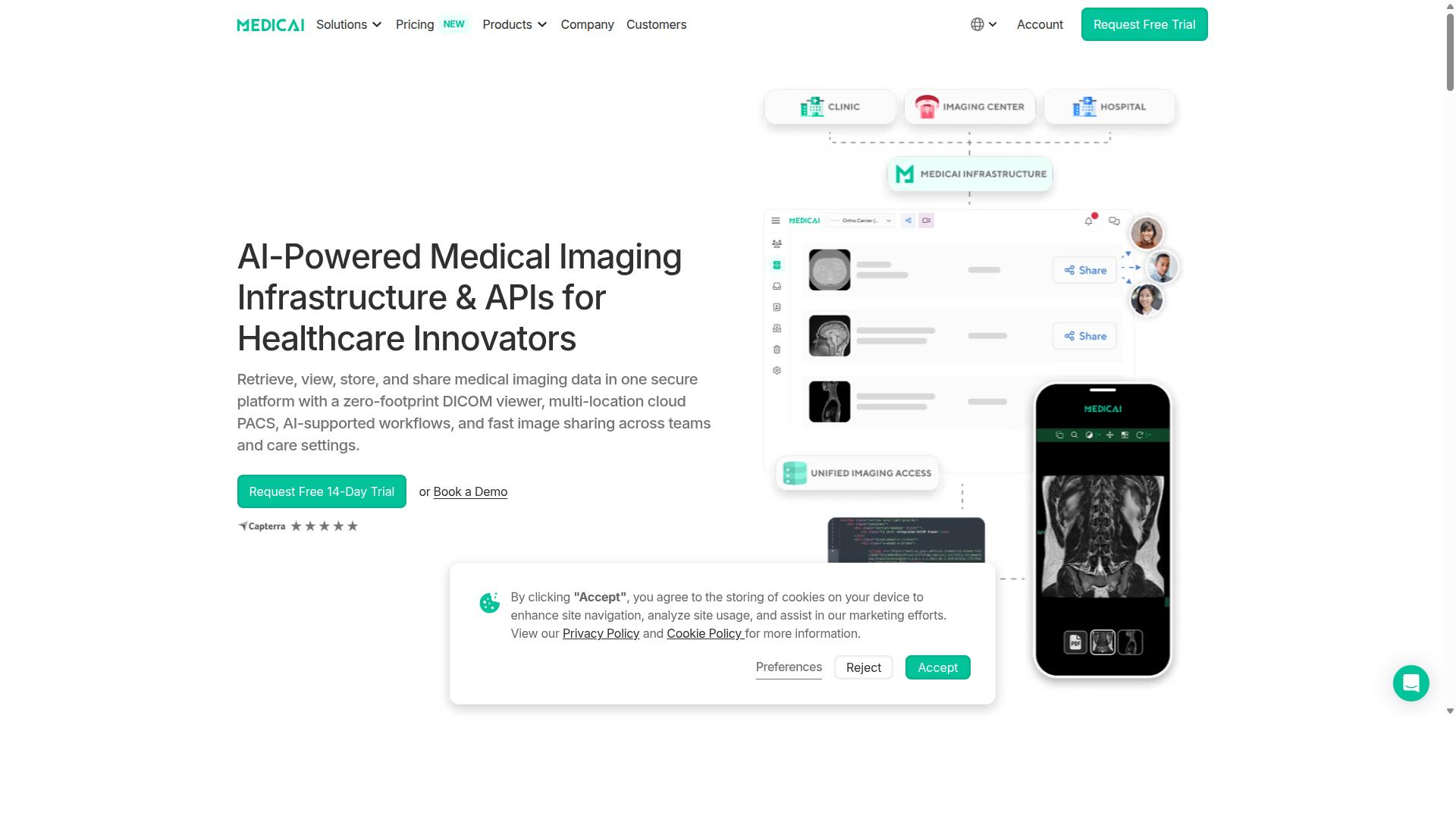
Medicai operates as a cloud-based medical imaging platform that enables healthcare providers to retrieve, view, store, and share medical imaging data in one secure platform. This approach supports artificial intelligence integration by providing consistent access to imaging studies across different care locations.
The platform features a zero-footprint DICOM viewer that functions directly in web browsers without software installation. Healthcare teams gain instant access to medical images from any location, which supports radiology workflow efficiency and remote collaboration between specialists.
Users upload imaging studies to the cloud PACS system and share them securely with other healthcare settings. The platform maintains DICOM compatibility throughout this process, ensuring that medical images remain accessible and properly formatted for different clinical systems and AI algorithms.
Medical facilities use this workflow to move studies between departments, external partners, and specialist consultations. The interoperability features allow imaging data to flow smoothly between various healthcare providers while preserving diagnostic quality and supporting clinical decision support tools.
Why Medicai Leads in Artificial Intelligence Integration
Medicai embeds AI algorithms directly into its imaging workflow to reduce interpretation time and improve diagnostic accuracy. This approach keeps everything within the existing system rather than adding extra layers.
Many platforms require separate servers to run machine learning models. Medicai processes AI tasks on the current DICOM data already stored in the system. Radiologists avoid switching between tools or managing additional infrastructure.
The workflow begins when a chest CT arrives in the system. AI algorithms pre-process the study before the radiologist opens it. Automated analysis flags areas of interest such as nodules or vascular changes. When the radiologist accesses the case, preliminary findings and measurements appear alongside the images.
This setup streamlines the radiology workflow by handling routine detection tasks automatically. Radiologists spend less time on initial review and more time on complex interpretation. The system maintains full DICOM compatibility throughout each step.
Neural networks run within the same environment as the medical imaging data. No external servers or duplicate storage systems are needed. This method supports real-time processing while preserving data security standards.
Experts recommend this integrated approach because it reduces errors from manual data transfers. The platform handles AI model deployment without disrupting existing clinical decision support tools. Patient outcomes improve when radiologists receive consistent, timely assistance during image review.
AI-Supported Workflows and Partnerships
Medicai integrates third-party AI solutions through existing partnerships to deliver automated analysis inside the viewer. The platform connects with MD.ai, Rayscape.ai, and OHIF to bring different analysis capabilities into one workspace. These connections allow teams to use specialized tools without switching between separate applications.
API connectivity supports custom model deployment for organizations that want to run their own algorithms. Hospitals and clinics can connect their trained models to the same environment where radiologists review studies. This setup keeps workflows inside a single interface rather than moving files between systems.
One concrete workflow shows an AI finding from Rayscape.ai displayed directly in the same viewer window. The radiologist sees the flagged area while reviewing the original study, which reduces the need to open additional software. The integrated view helps maintain focus during interpretation sessions.
Partnerships with Microsoft Azure and Amazon AWS provide the infrastructure that supports these connections. The platform also works with MedDream and Meditice to expand available tools for different specialties. These relationships create a network of analysis options that fit various clinical needs.
Key Features and What Makes Medicai Stand Out
Medicai combines a vendor-neutral archive with real-time AI processing, all accessible through a HIPAA-compliant cloud viewer. The platform offers structured reporting for radiology alongside doctor and patient imaging portals. This approach supports both clinical teams and individuals who need secure access to medical images.
Traditional PACS systems often lock health systems into single-vendor environments with limited data exchange. Medicai uses a vendor neutral archive that stores DICOM studies from any manufacturer. The architecture supports both cloud PACS and medical image exchange without restricting future technology choices.
Consider a multi-location hospital system where a patient arrives at a different facility than the one where prior imaging occurred. Staff can use the Connect and Retrieve tools to pull earlier studies through the Medical Imaging Uploader or DICOM Gateway. This instant access eliminates repeat scans and supports continuity of care across sites.
Interoperability relies on established standards. Medicai supports DICOMweb for web-based image transfer and FHIR for integration with electronic health record systems. These protocols allow the platform to communicate with existing hospital infrastructure while maintaining data integrity.
The Store and Manage capabilities include backup and disaster recovery alongside patient case management. These services ensure medical imaging data remains available and protected. The Access, Visualize, and Collaborate features encompass a DICOM Viewer, Mobile Imaging App, and Medicai Imaging API for various clinical workflows.
Artificial intelligence integration occurs through the Radiology AI Co-Pilot and AI-Powered Diagnostics offerings. These tools work within the existing archive structure rather than requiring separate systems. The Teleradiology and Medical Image Sharing Platform components extend AI insights to remote specialists and referring physicians.
Additional support for Tumor Boards allows multidisciplinary teams to review imaging findings in one location. The platform scales to accommodate growing data volumes without changes to core infrastructure. This combination of vendor-neutral storage, standard-based interoperability, and embedded AI tools distinguishes Medicai in medical imaging environments.
Pricing and Plans
Medicai offers monthly subscription plans that scale storage and connected locations based on organizational size. The platform provides clearly defined tiers that match different practice requirements in medical imaging and artificial intelligence integration.
Starter plan costs $249 per month and includes 500 GB of cloud storage with unlimited user accounts. This tier has no connected locations, making it suitable for smaller teams or initial testing of AI workflows.
Standard plan costs $749 per month and provides 2 TB cloud storage with one connected location. This option supports larger practices that need to integrate AI algorithms with existing PACS systems and medical imaging equipment.
Adding connected locations increases both the price and storage allocation. Enterprise plan uses custom pricing to accommodate multiple connected locations and external sites, allowing healthcare organizations to expand their artificial intelligence integration across several facilities.
Yearly billing provides 15 percent savings compared to monthly payments. The Starter plan reduces to $209 per month when paid yearly, while the Standard plan reduces to $639 per month.
DICOM Gateway Setup costs $1,000 one time per location. Organizations can start with a free 14-day trial of Starter plan features without providing a credit card.
Trust Signals
Medicai publishes verifiable compliance metrics that include 1 M+ studies processed yearly, 1.7 M+ studies stored, and 50 M+ API transactions annually.
These numbers establish a clear track record of clinical adoption. The platform also reports 300k+ visualizations of DICOM studies completed during the past year.
Regulatory clearances provide another layer of assurance. FDA and CEE cleared viewers mean the software meets recognized standards for medical imaging interpretation.
Data protection receives equal attention. The platform maintains HIPAA and GDPR compliance while following OWASP security guidelines across all operations.
Real-world usage further confirms reliability. Seventy clinics and hospitals currently run the system with more than 10,000 active doctors accessing patient data daily.
Who Should Use Medicai
Hospitals, imaging centers, and specialty clinics in orthopedics, neurology, oncology, cardiology, and other imaging-heavy fields benefit from Medicai's integrated AI and storage capabilities.
The platform serves healthcare providers including orthopedics, neurology, oncology, radiology, cardiology, ophthalmology, ob-gyn, pulmonology, dentistry, and gastroenterology departments.
Additional users include virtual care providers, telemedicine platforms, teleradiology services, personal injury lawyers, tumor boards, clinical trials, and medical education organizations.
Patients also access the system through the Patient Portal for direct viewing and management of their imaging studies.
- Orthopedics departments use Medicai for AI-assisted measurements of bone structures and joint angles to support surgical planning and follow-up assessments.
- Oncology teams rely on the platform for tumor tracking across multiple scans, allowing consistent comparison of lesion size and response to treatment over time.
- Radiology departments achieve faster turnaround times as AI algorithms pre-analyze studies and flag areas that require immediate radiologist attention.